
Does compost really attract mosquitoes, or is the problem related to the type of composter and its location? The answer depends on several measurable factors: the degree of residual moisture, the level of confinement of the bin, and the surrounding urban density. Understanding these variables allows for the selection of an appropriate device and reduces the larval risk without giving up home composting.
Closed worm composter or traditional bin: what impact on mosquito risk
The type of composter directly modifies the conditions favorable to mosquito breeding. An open or poorly ventilated bin more easily accumulates pockets of stagnant water in the organic matter. A closed continuous flow worm composter, thanks to its controlled aeration, limits the formation of these micro-reservoirs.
According to a technical bulletin from INRAE dedicated to pest management in home composting, closed worm composters significantly reduce larval emergence compared to traditional piles. The mechanism relies on the constant drainage of compost tea and the absence of accessible free water surfaces for female mosquitoes.
| Criterion | Open traditional bin | Closed continuous flow worm composter |
|---|---|---|
| Accumulation of stagnant water | Frequent if no drainage | Limited by the recovery tap |
| Aeration of the material | Depends on manual turning | Controlled by the tray structure |
| Exposure to breeding | High (open surface) | Low (lid and closed walls) |
| Adaptation to urban balcony | Not practical, bulky | Compact, designed for small spaces |
| Risk of odors attracting other insects | Moderate to high | Low if carbon/nitrogen ratio is respected |
In dense urban environments, where balconies and terraces concentrate heat and humidity, the closed worm composter has a clear advantage. The relationship between compost and the presence of mosquitoes thus depends as much on the container as on the content.
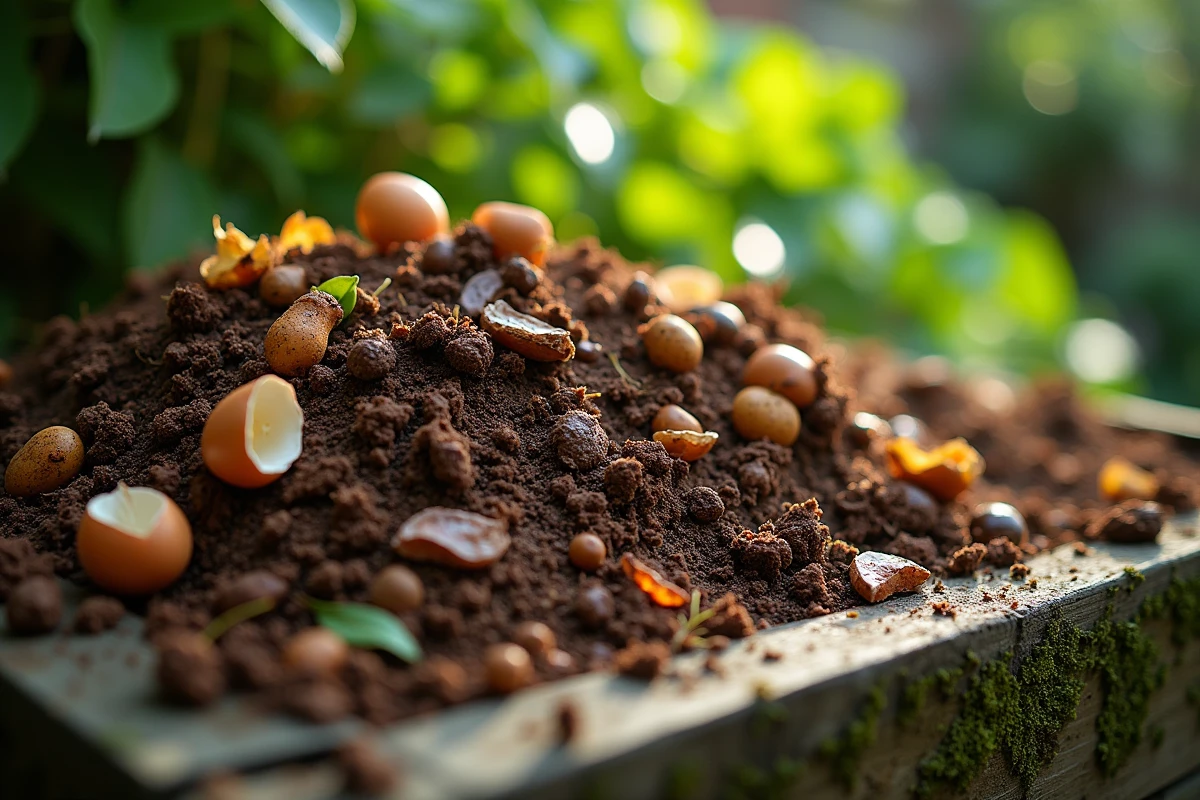
Stagnant water in the composter: the determining factor for mosquitoes
Mosquitoes do not lay eggs in the organic matter itself. They seek stagnant water surfaces, even tiny ones. A poorly drained bin bottom, a concave lid that retains rainwater, a worm composter tray not emptied for several days: each micro-reservoir is enough to host a breeding.
Emptying the compost juice at least twice a week eliminates this breeding opportunity. The tiger mosquito, present in much of France, can complete its larval cycle in less than a week in warm, organic-rich water.
Water retention points to monitor on a composter
- The bottom of the bin, especially if it rests on a flat surface without elevation or drainage grid
- The lid or upper edges, where rainwater can stagnate after a storm
- The intermediate trays of a worm composter, when the compost tea is not regularly harvested
- The saucers or containers placed under the composter to protect a balcony
A well-drained composter, even of the traditional type, reduces the risk to a level comparable to that of a closed worm composter. Drainage remains the central parameter, regardless of the chosen model.
Carbon-nitrogen ratio and gnats: a common confusion with mosquitoes
Many home composters confuse gnats and mosquitoes. The small black flies that fly away when the bin is opened are generally fruit flies or fungus gnats, attracted by an excess of wet waste (fruit peels, soaked coffee grounds). These insects do not bite and do not transmit diseases.
Too wet compost low in carbon material attracts gnats, not necessarily mosquitoes. However, both problems share a common cause: excess moisture. Restoring the carbon-nitrogen balance corrects both situations simultaneously.
Dry materials to add to correct excess moisture
- Unprinted brown cardboard, cut into pieces a few centimeters long
- Dry dead leaves, ideally stored in a bag for use throughout the year
- Shredded branches or untreated wood chips, in a thin layer after each addition of kitchen waste
Adding a handful of dry material with each addition of green waste is the simplest method to maintain a correct moisture level. The compost should have the consistency of a wrung-out sponge, neither dripping nor powdery.
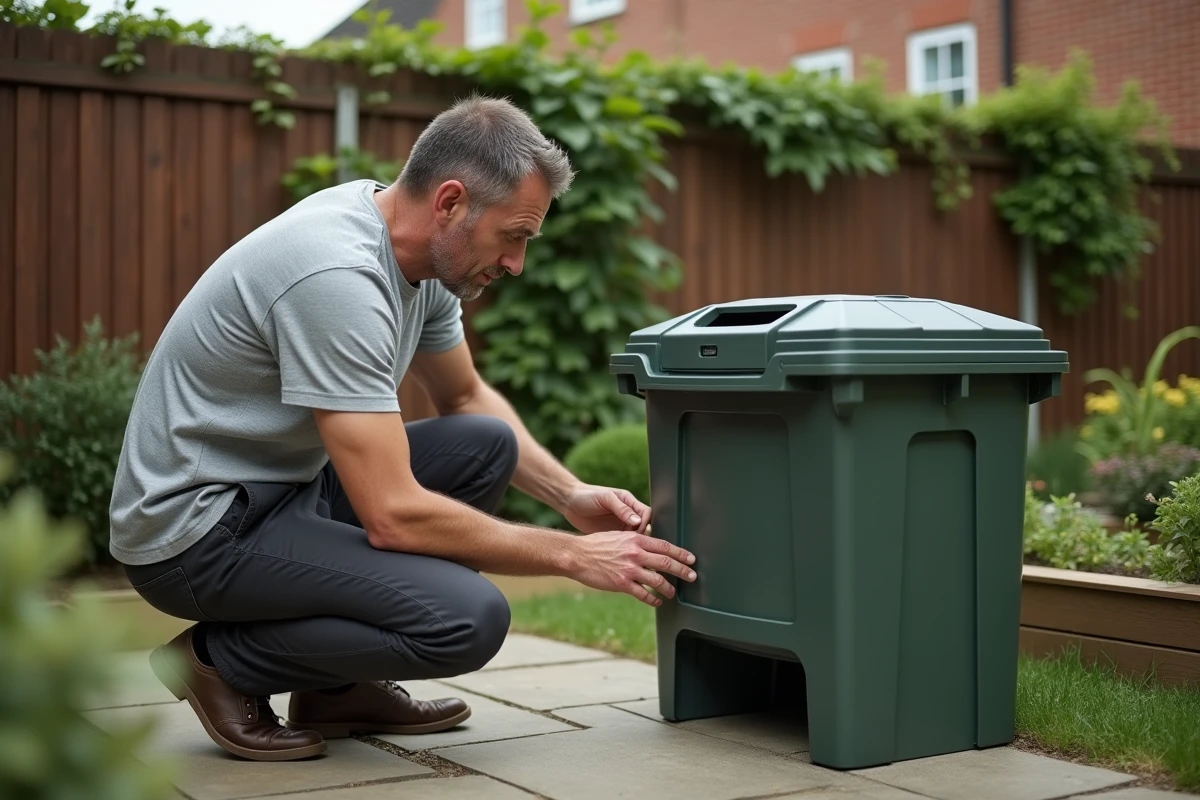
Composter on a balcony in the city: specific adaptations against insects
In urban environments, composting on a balcony combines two constraints: the immediate proximity of living spaces and the heat island effect that accelerates decomposition and evaporation. A poorly managed composter on a south-facing balcony can generate nuisances in just a few days.
The worm composter remains the best-suited format for balconies. Its compactness, closed system, and integrated drainage meet the three conditions that limit the presence of mosquitoes: absence of free water, passive ventilation, and confinement of odors.
A fine mesh mosquito net fixed over the vents provides an additional physical barrier. This precaution, often overlooked, prevents females from laying eggs in the crevices of the composter during the warm months.
For traditional bins installed at the foot of a building, elevating them on blocks allows for checking the absence of water under the bin. Any container placed under the composter must be emptied within 24 hours after rain, as recommended by French health authorities to limit the proliferation of the tiger mosquito.
The choice of composter, its location, and the frequency of leachate emptying together determine the level of risk. A closed worm composter on a well-ventilated balcony, emptied regularly, poses no more mosquito risk than a well-maintained flower pot.