
Rectifying a declared living area is not merely a simple administrative adjustment. Between measurement discrepancies that affect property tax, the loss of square meters after interior insulation, and the confusion between the Boutin law and the Carrez law, the situations that trigger a rectification are more varied than one might think. What discrepancies truly justify a process, and through which channel should it be conducted?
Impact of interior insulation on the declared living area
Competitors extensively discuss the definition of living area or the steps for online declaration. They overlook a concrete trigger for rectification: thermal renovation from the inside.
An internal insulating lining generally adds between 5 and 10 cm per wall. An insulated partition, often used for sound insulation, adds between 8 and 15 cm per surface. In a medium-sized room with three or four affected walls, the actually available floor area decreases measurably.
After a significant renovation, the living area recorded in the sales deed or in the tax declaration may no longer correspond to reality. Before reselling or renewing a lease, it is necessary to recalculate the area taking these new thicknesses into account, and then declare the modification to the tax authorities. To better understand the methods on Bâtir Architecte, the recalculation is based on a precise measurement of the interior dimensions after work, not on the initial plans of the dwelling.
| Type of intervention | Thickness added per wall | Effect on the living area |
|---|---|---|
| Internal insulating lining | 5 to 10 cm | Reduction to declare if multiple walls treated |
| Insulated partition (acoustic or thermal) | 8 to 15 cm | More pronounced, cumulative reduction |
| Attic conversion (ceiling height < 1.80 m) | Variable | Area excluded from the calculation of living area |

Rectification of living area and property tax: the process via impots.gouv.fr
Since the new obligations for declaring property occupancy established in 2023 and adjusted in 2024, tax services encourage property owners to verify the areas used for calculating property tax. The first step is to request the cadastral evaluation sheet for their property. This document details the area and nature of each room as known by the administration.
If a discrepancy appears between the cadastral sheet and reality (after insulation work, modification of partitions, conversion or removal of attics), a claim can be submitted directly online.
Secure messaging rather than registered mail
Surface rectifications increasingly go through the secure messaging of impots.gouv.fr, in the “Contact us / I have a complaint” tab for property tax. This channel allows for the submission of scaled plans, photos, and artisan certificates without a physical appointment or postal sending.
- First, request the cadastral evaluation sheet to identify the precise discrepancies between declared area and actual area.
- Gather supporting documents: scaled plan after work, quotes or invoices mentioning the thickness of insulation, certificate from a professional if necessary.
- Submit the claim via secure messaging specifying the nature of the error and the corrected area.
- Keep the digital acknowledgment of receipt and follow up on the response in the personal space.
This dematerialized procedure shortens processing times compared to a registered letter sent to the property tax center.
Boutin law and Carrez law: two areas, two contexts for rectification
The confusion between these two measurements generates a significant portion of surface errors. The Boutin law (article R.156-1 of the Construction Code) defines the living area used in residential leases. The Carrez law applies to the sale of condominium lots and includes certain areas excluded by Boutin (closed and heated verandas, for example).
Consequences of a discrepancy exceeding the tolerated threshold
In rentals, a living area error greater than 5% can justify a proportional rent reduction based on the observed discrepancy. The tenant has a period to initiate this action. In sales under the Carrez law, a discrepancy greater than 5% entitles the buyer to a proportional reduction in price.
On the other hand, an error below this threshold does not result in any legal compensation, even if it alters the perception of the property. This is why the initial measurement deserves special attention, especially in properties with atypical configurations (partially converted attics, mezzanines, mansard rooms).
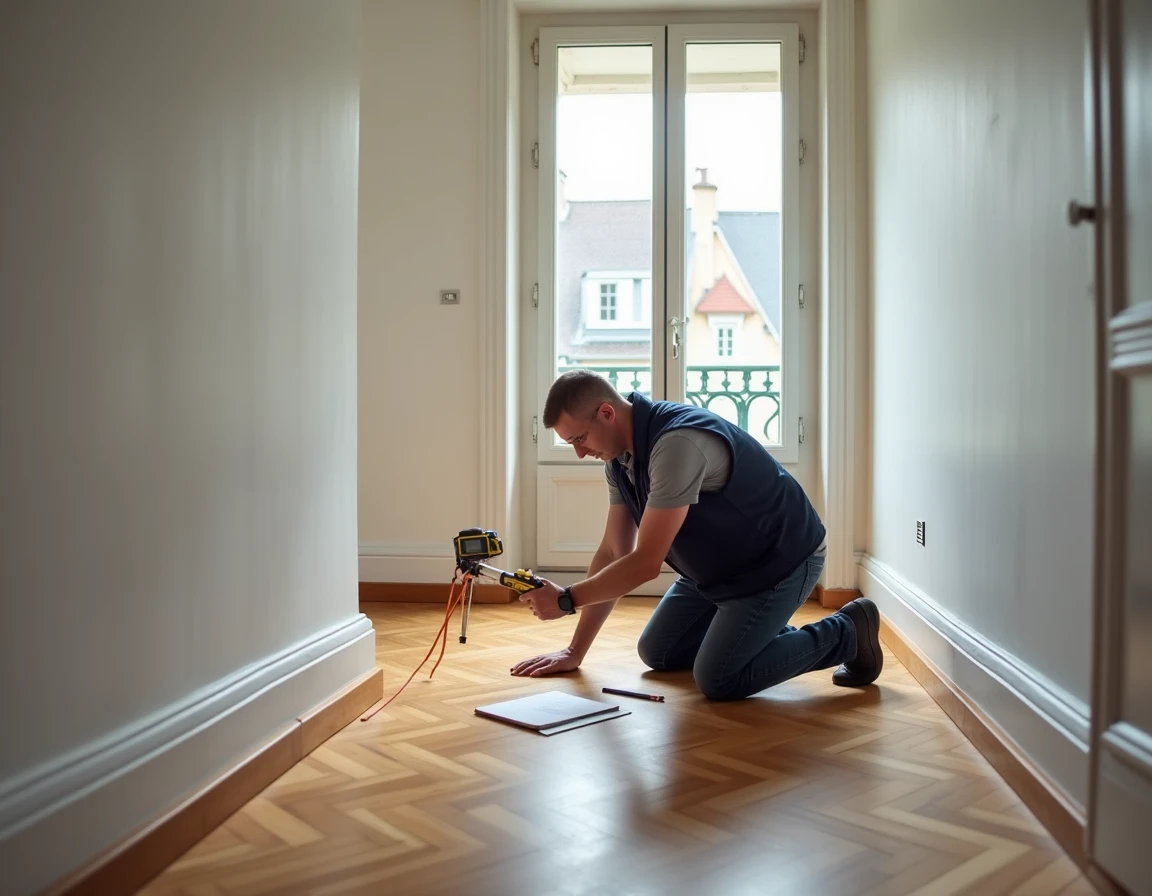
Areas excluded from the calculation: zones that often trap
Rectification errors do not always concern walls. They also involve areas incorrectly counted in the living area.
- Any area where the ceiling height is less than 1.80 m must be excluded: sloping ceilings, corners of attics, low parts of mezzanines.
- Bases, garages, unfinished basements, unfinished attics, and sheds never count.
- Balconies, terraces, loggias, and unheated verandas are excluded from the living area as defined by the Boutin law.
During an attic conversion, only the part where the height exceeds 1.80 m is included in the calculation. A converted attic into a bedroom does not automatically add its entire area to the declared living area. The measurement should be taken after the flooring and insulation have been installed, not based on the initial architect’s plan.
The rectification of a living area hinges on precise data: insulation thickness, ceiling height after work, exact nature of the rooms declared in the cadastral records. Requesting the cadastral evaluation sheet remains the first reflex before any tax claim or sale. A discrepancy of a few square meters can alter a rent, property tax, or the price of a transaction.