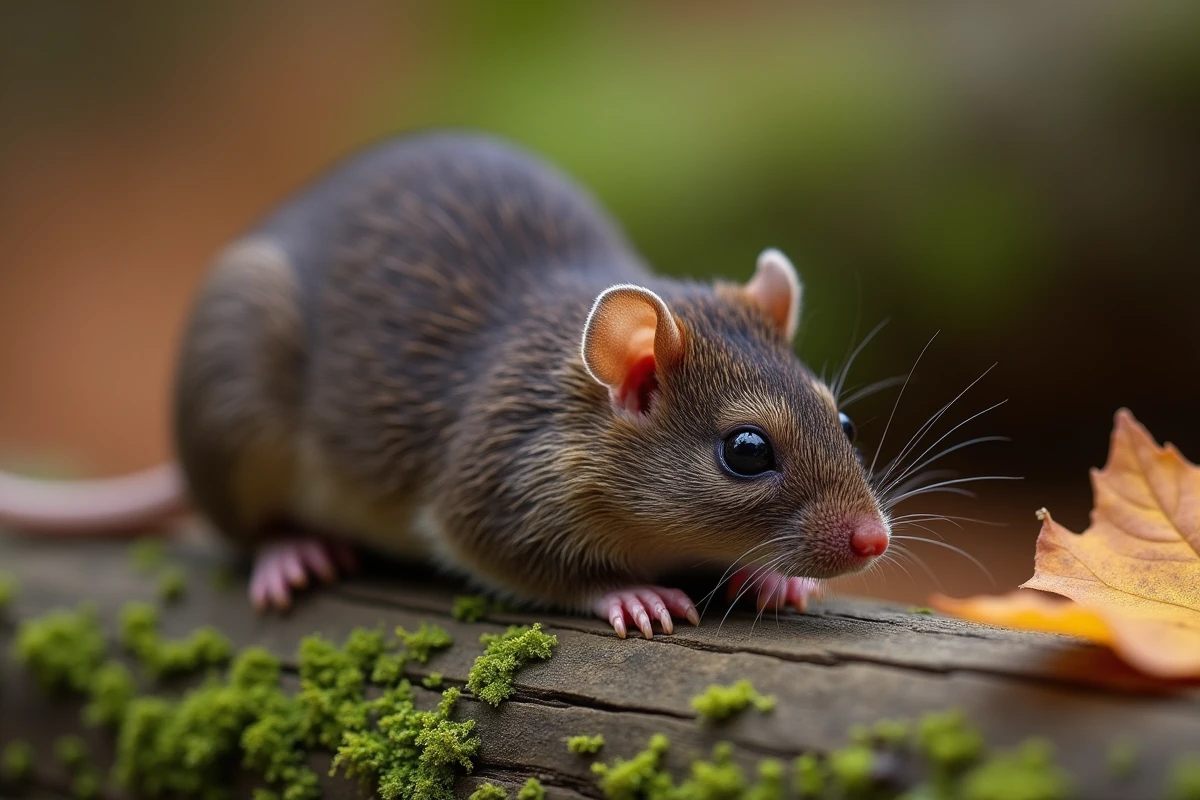
The shrew occupies a unique place in animal symbolic systems. Its Latin etymology, musaraneus (composed of mus, mouse, and araneus, spider), reveals an ancient perception: that of an animal whose bite rivaled, in ancient imagination, the venomous sting of the spider. This semantic shift has durably marked the symbolic charge of the animal, far beyond its zoological reality.
Shrew totem and psychopomp function: what ancient Egypt teaches us
The best-documented spiritual function of the shrew concerns its role in Egyptian religion. The shrew was associated with the goddess Wadjet and considered a animal linked to the passage between worlds. Mummies of shrews have been found in necropolises, attesting to a ritual treatment reserved for animals with strong sacred significance.
This psychopomp function (guiding the dead) is based on a specific behavioral trait: the shrew lives in the shadows, digs in the earth, and moves between the surface and the depths. For Egyptian priests, this animal embodied the ability to navigate between the visible and the invisible.
To delve deeper into the spiritual symbolism of the shrew in European domestic traditions, the connection with this Egyptian funerary function becomes clear. The animal is not just a sign of good or bad omen: it carries a symbolism of transition.
Native American symbolism of the shrew: curiosity and transgression
The European view of the shrew as a symbol of discreet perseverance is not universally accepted. Among the Navajo people, the shrew embodies excessive curiosity leading to madness. The ethnographic study “Forgotten Totem Animals” from the University of Arizona, published in September 2025, documents this frontal opposition to the traditions of the Old Continent.
In this cosmogony, the shrew is not a protective totem. It represents what happens when the spirit crosses certain boundaries: a quest for knowledge that exceeds human capacity to absorb the world. The shrew totem animal, among the Navajo, warns rather than guides.
Opposition Europe-North America on the shrew totem
We observe two radically incompatible readings of the same animal:
- In Western Europe, the shrew symbolizes tenacity, attention to detail, and the ability to survive in the shadows, a generally positive image despite domestic superstitions
- In Navajo territory, it signals an excess of curiosity, a crossing of dangerous spiritual thresholds, and serves as a warning against obsessive questing
- In ancient Egypt, it is neither positive nor negative: it is functional, linked to the transit of souls and the underworld
These divergences show that the symbolic charge of an animal depends entirely on the cultural relationship to the territory it inhabits. The European shrew lives near homes, hence its connection to domestic omens. The shrew of the American Southwest evolves in a hostile environment, which colors its image differently.
Climate change and the disappearance of shrews: a threatened living totem
A totem functions as long as the animal exists in the immediate environment of the community that assigns it meaning. The accelerated disappearance of certain shrew species due to climate change poses a concrete problem for spiritual traditions based on their physical presence.
Several species of shrews with restricted ranges are directly affected by habitat modification. When a totem animal disappears from the daily landscape, the link between the symbol and lived experience breaks. The symbolism survives for a time through oral transmission, then fossilizes into superstition disconnected from any real encounter.
Consequences for contemporary spiritual practices
Aromatherapy therapists have reported an increase in visions of shrews as spiritual guides during sessions with essential oils. This phenomenon raises questions: does the shrew become a symbol of what is disappearing?
If the animal becomes rarer in daily life, its symbolic charge could shift towards the realm of ecological mourning. The shrew totem would no longer be a sign of perseverance or vigilance, but a reminder of the fragility of the living world. This shift in meaning is already perceptible in circles of reflection that intersect ecology and animal spirituality.
Shrew in dreams: a reading grid beyond the dream dictionary
Dream dictionaries assign a generic meaning to the shrew related to discretion or fear of insignificance. We recommend a finer reading, grounded in the dreamer’s life context.
Dreaming of an active and fast shrew refers to an underground work of the psyche, a process underway of which the dreamer is not yet aware. The image of this animal digging, scratching, and constantly moving in the lower layers of the ground corresponds to foundational work, not surface anxiety.
In contrast, a stationary or dead shrew in a dream may signal a blockage in this underground dynamic. The small mammal then loses its main attribute (perpetual movement, the vital energy that never extinguishes) and becomes a sign of inertia.
The small size of the animal in the dream is not an indicator of weakness. It points to a neglected detail that demands attention. The dream shrew functions like a spotlight focused on what the dreamer refuses to look at closely.
The shrew remains one of the few animals whose spiritual symbolism varies greatly according to cultures and eras. Its gradual disappearance from certain ecosystems is already transforming the nature of the symbol it carries. What was once a living totem, observable in a garden or underbrush, is slipping towards an abstract figure, increasingly distant from direct experience with the animal.